

Visual Storytelling in the Age of AI:
From Tools to Meaning
Bellandi · Content Strategy · AI & Meaning
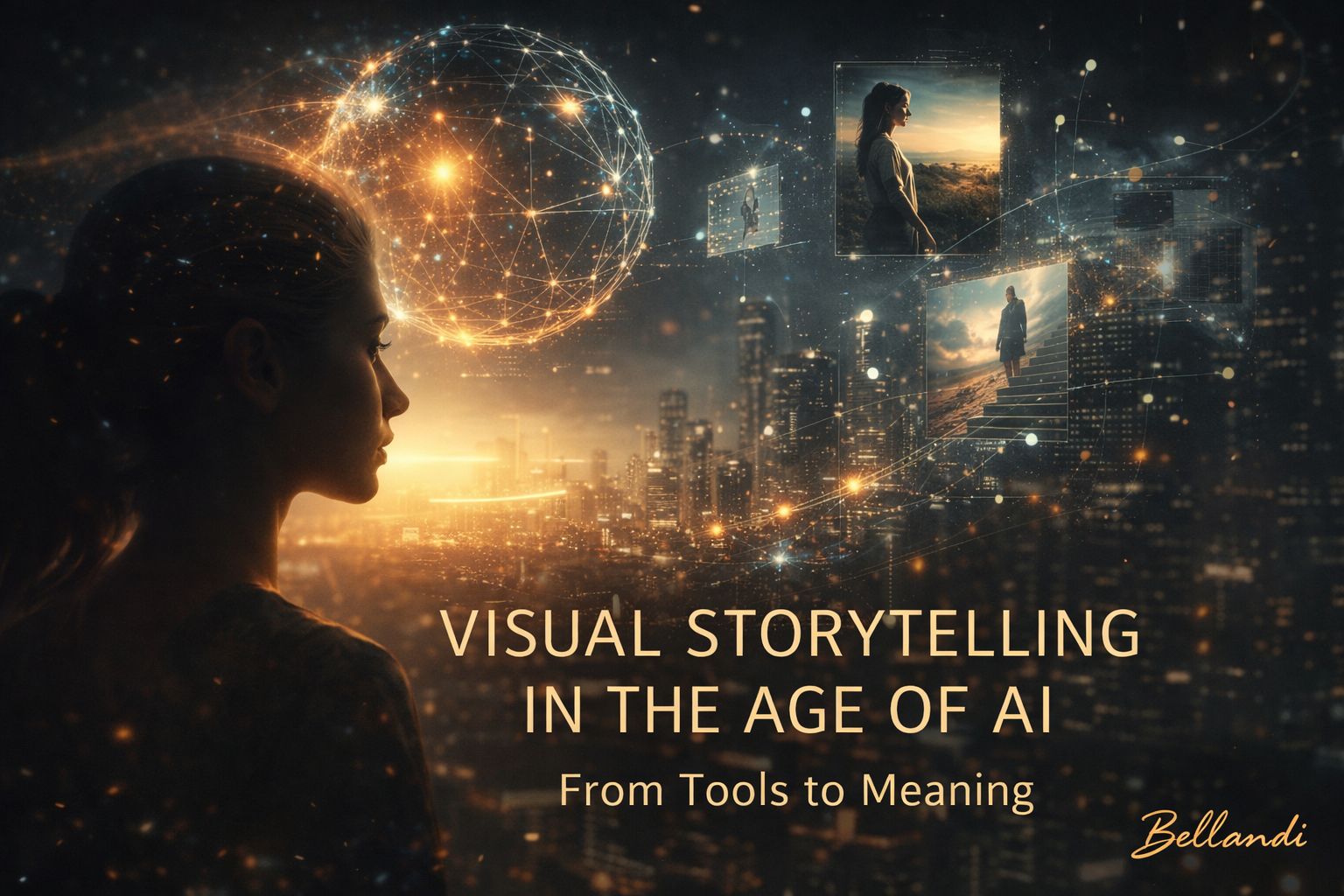
AI tools can generate images, video clips and entire visual concepts in seconds. But when creation becomes effortless, meaning often becomes optional. The result is content that looks refined and feels empty.
Visual storytelling still obeys the same laws it always has. A strong image is not defined by the tool that produced it, but by the intent behind it: point of view, tension, restraint and clarity. AI accelerates execution. It does not replace judgement.
Tools are not the story
A tool is a brush, not the painter. If the concept is weak, AI will simply generate a faster version of weak. If the concept is strong, AI becomes a force multiplier — more variations, faster iteration, fewer technical limits.
Meaning is created through selection
The real work begins after generation. What stays. What disappears. What is emphasised. Composition, colour, contrast and silence are decisions. And decisions are where meaning lives.
The viewer needs an anchor
Infinite feeds train people to scan, not to read. Faces, familiar objects, recognisable symbols and restrained emotion act as anchors. Pure abstraction rarely survives long enough to be understood.
AI works best as a system, not a shortcut
Effective use of AI looks less like a miracle prompt and more like a pipeline: concept → variation → selection → refinement → consistency. Speed without structure only produces rubbish.
From tools to meaning
AI does not replace creators. It removes friction and exposes the real skill: taste, structure, restraint and the ability to say something precise in a crowded space.
AI can generate images. Only humans can generate reasons to remember them.
- Bellandi